1 December 2026
The Whole Researcher ~ Programme
At a glance
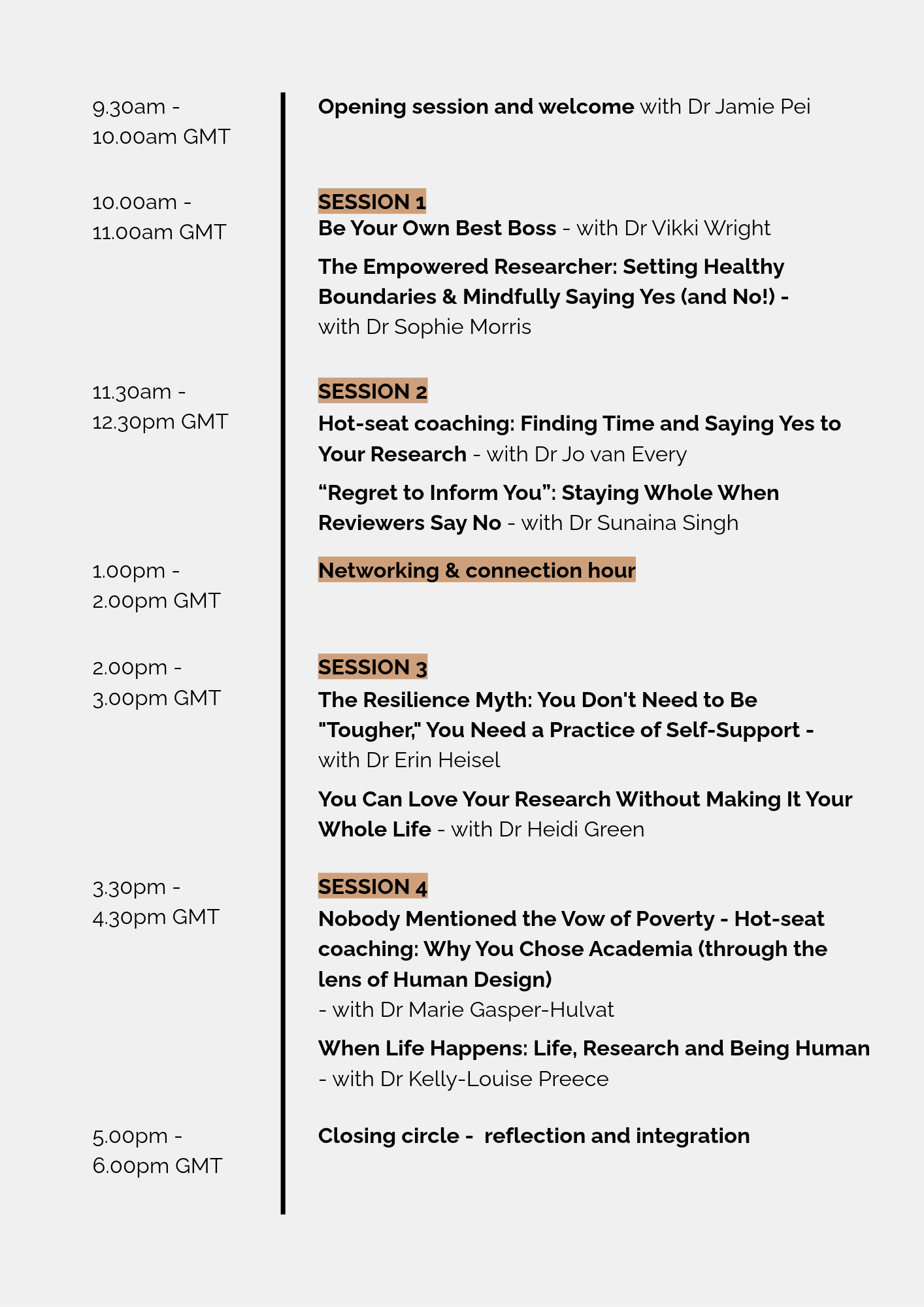
The Full Details

Opening and Welcome
9.30 - 10.00am GMT / 4.30 - 5.00am ET
with host Dr Jamie Pei
We'll gather to say hello, meet each other and do some light intros.
I'll lead everyone through a short, gentle meditation and intention setting for the day, before we head into the first round of sessions!
Session 1
10.00am - 11.00am GMT / 5.00am - 6.00am ET
Be Your Own Best Boss
with Dr Vikki Wright
If you’ve ever planned unrealistically, ruminated on failures, overlooked successes or told yourself that you’re just not good enough to be here, then you’re completely normal ... but it still feels rubbish.
Imagine working for a boss who treats you like that? You’d hate it.
In this session, we’ll explore the benefit of separating “boss you” from “implementer you” and make some tangible decisions about how to be a better boss to yourself.
The Empowered Researcher: Setting Healthy Boundaries & Mindfully Saying Yes
(and No!)
with Dr Sophie Morris
Research can bring a constant stream of opportunities, expectations and competing demands, making it difficult to know when to say yes and when to protect our time and energy.
This interactive and reflective session will explore what healthy boundaries can look like in research and academic life. Participants will consider their own priorities, values and capacity, identify where boundaries may need strengthening, and practise making more mindful decisions about the opportunities they take on.
Through practical tools and shared reflection, the session will support researchers to say "yes" with intention, "no" with confidence, and "not yet" when the timing isn’t right.
Session 2
11.30am - 12.30pm GMT / 6.30am - 7.39am ET
Hot-seat coaching: Finding Time and Saying Yes to Your Research
with Dr jO vAN every
In this hotseat coaching session Jo will coach 3 or 4 participants through an instance when you’ve struggled (or are currently struggling) to prioritise your own research.
It’s hard to fit writing in amongst all your other competing responsibilities: Your colleague is waiting on that thing. A student is struggling. Your kids get sick. Putting yourself and your writing first might seem selfish. You might not even mean to keep putting your writing on the backburner. But it keeps happening, again and again. It is not as simple as just “getting better at saying no”.
Together, we’ll figure out a way forward.
“Regret to Inform You”: Staying Whole When Reviewers Say No
with Dr Sunaina singh
Every researcher has a rejection story: desk-rejected papers, the grant that went nowhere, rejected job applications. What follows is the usual spiel: rejection is “a silver lining” or “learning opportunity,” or “it was not meant to be”! In this session, I intend to change the narrative.
Drawing on years of helping researchers through resubmissions, I'll work with you to separate what a rejection actually says from what we assume it means about us: That rejection is not the same as failure.
Together, we will make room for the range of feelings rejection elicits and work through tools to deal with them. You will leave with a practical debrief for the next “regret to inform you” email so that you so you can dispel self-doubt and fear of the next rejection while staying whole.
Networking & Connection Hour
1.00pm - 2.00pm GMT / 8.00am - 9.00am ET

'Choose Your Own Adventure' networking and connection hour
This is not your normal networking. No cringey small talk or awkward prompts to "share a fun fact about you".
Instead, everyone will pick from a range of themed rooms, find your own people and chat about what matters to you.
If you're not vibing, you can leave and try another room - you get to make the hour work for you. Everyone’s welcome, whether you’re a PhD, ECR, researcher developer or research-adjacent.
Session 3
2.00pm - 3.00pm GMT / 9.00am - 10.00am ET
The Resilience Myth: You Don't Need to Be "Tougher," You Need a Practice of Self-Support
with Dr ERIN Heisel
The “thick skin” messaging in academia effectively shuts down resistance practices and excludes the humanness that makes research enriching. Enough of that! In this session, we’ll work through an effective, adaptable practice to help you navigate the aftermath of challenging encounters in academic settings and beyond.
ECRs and PhDs, use this practice to reconnect to your inner voice and re-centre your experience as a researcher. For researchers holding tenure or senior administrative positions, this practice can help you stay grounded as you work to create positive change in your departments and institutions.
You Can Love Your Research Without Making It Your Whole Life
with Dr HEIDI GREEN
You can love your research, care deeply about what you do, and still want a life outside of your work.
This interactive and reflective session invites you to reconnect with the adventures, communities, side-quests and joys that matter to you beyond your work.
Together, we’ll explore what can get squeezed out when research takes up too much space, and play with ways to bring more of what we love into our working lives, without having to care any less about our research.
Session 4
3.30pm - 4.30pm GMT / 10.30 - 11.30am ET
Nobody Mentioned the Vow of Poverty
Hot-seat coaching: Why You Chose Academia (through the lens of Human Design)
with Dr MARIE GaSPeR-HULVAT
In this hotseat coaching session, Marie (tenured art history professor and Quantum Human Design™ Specialist) will lead a group discussion about the unspoken reasons that led you into academia in the first place. She'll pick a few volunteers for hot seat coaching, reading their Human Design charts on the spot based on what she hears within and underneath their words.
Participants will walk away with a deeper understanding of how their energetic blueprint, determined at birth, affects their relationship with academia and the implicit vow of poverty that becoming an academic often entails.
NOTE: Please get your free Human Design chart here before Marie’s session if you want to stand a chance of being hot-seat coached
When Life Happens: Life, Research and Being Human
with Dr Kelly-louise preece
This session will explore how to navigate the realities of life during a research journey. From joyful but all-consuming milestones such as moving house, getting married or having a child, to the challenges of caring responsibilities, grief or trauma, life does not pause while research continues.
Together, we will consider how to build a personal ‘toolbox’ of support for both your wellbeing and your research.
Drawing on my lived experience of navigating all of these experiences while working in academia, the session will offer practical strategies, reflection and reassurance that being a researcher and being human are not separate things.
Closing: Reflection & Integration
5.00 - 6.00pm GMT / 12.00 - 1.00pm ET
with host Dr Jamie Pei
In our final hour, we'll all reconvene to reflect and integrate what we experienced, learned or enjoyed over the day.
You'll have the opportunity to share what came up for you (not compulsory; only if you feel called to), give a shoutout to any facilitators or fellow researchers you've met and loved, and to round off the day with a little sacred kiki-ing!
We'll close with a final short meditation to land all the good stuff of the day and to bring our whole, best, human selves back into our lives, work and research.

Join the full day of The Whole Researcher
It's not too late to join The Whole Researcher if you haven't already. A full-day ticket - at only £37 - will give you access to all the guided gatherings, and the opening, closing and networking sessions.